Executive summary
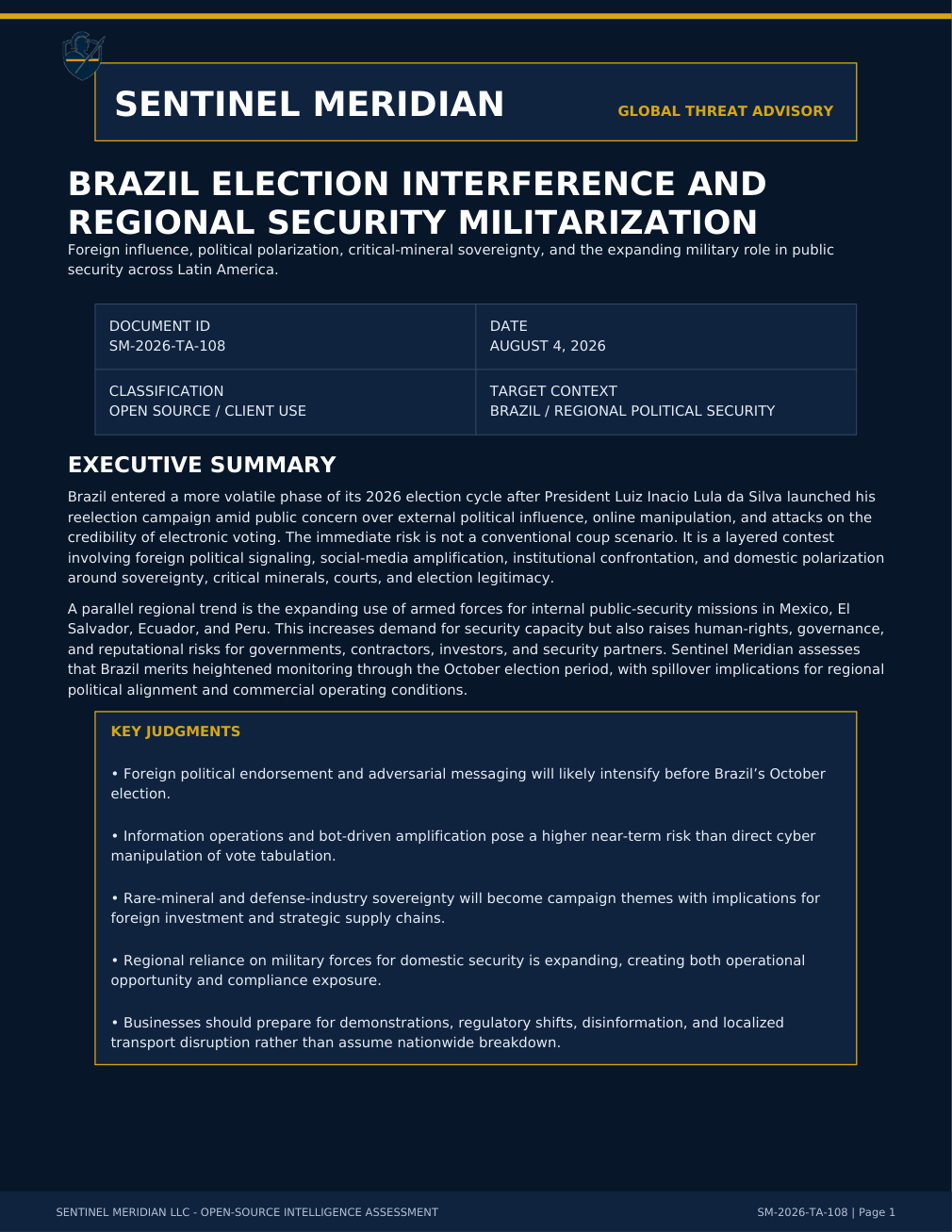
Brazil is in the active campaign phase ahead of the October 2026 general election. The contest is being conducted in an information environment shaped by durable political polarisation, recurring claims about the integrity of the electronic voting system, and allegations of foreign involvement in domestic political disputes. The same period has seen continued expansion of military participation in public-security tasks across Latin America, a structural trend that outlasts any single election. UPDATE, 3 SEPTEMBER 2026: Reuters reporting dated 3 September 2026 describes an intensifying campaign in which polling, candidate positioning, and interference allegations are all contested. Sentinel Meridian treats specific poll numbers as attributable to the publishing institute and survey period rather than as a settled measure of national opinion, and treats interference allegations as claims attributable to the party, official, or institution making them. Where reporting cites official investigations, the existence of the investigation is the verified fact, not its conclusion. The operative risk for clients is not the identity of the winner. It is the concentration of contestation into the period between the first round, any run-off, and certification, when legal challenges, mobilisation, and platform-level information operations peak simultaneously. Sentinel Meridian assesses elevated but manageable disruption risk concentrated in major urban centres and around federal institutions in Brasilia.
- Information operations and disinformation
- 5/5
- Political polarisation and mobilisation
- 5/5
- Post-election legal contestation
- 4/5
- Urban disruption around key sites
- 4/5
- Foreign-influence allegations
- 4/5
- Electoral-system technical failure
- 2/5
Relative severity through the October 2026 election and certification period, updated 3 September 2026.
Key judgments
- The campaign is highly polarised and the information environment is contested; narrative disputes over electoral-system integrity are recurring rather than novel.
- Polling should be read as a range across institutes and dates, not as a point estimate; individual surveys are attributed to their publisher and field period.
- Foreign-influence allegations are politically salient and are being advanced by multiple actors; they are treated as claims pending competent-authority findings.
- Electoral institutions retain operational capacity, and the technical conduct of the vote is not assessed to be the primary risk.
- The highest-risk window runs from the first round through certification, when legal challenge, street mobilisation, and online amplification coincide.
- Urban disruption risk concentrates in Sao Paulo, Rio de Janeiro, and Brasilia, particularly around federal buildings, electoral courts, and party headquarters.
- Military involvement in public security continues to expand regionally; in Brazil this raises civil-military and legitimacy questions that persist beyond the election.
- Post-election policy uncertainty affects energy, environmental enforcement, trade alignment, and security cooperation more than day-to-day commercial operations.
- Platform moderation decisions and judicial orders against online accounts will remain a flashpoint in the campaign's final weeks.
The full assessment, including sourcing, analytic confidence statements, and indicators and warnings, is available in the downloadable PDF.
Download full PDF