
Executive summary
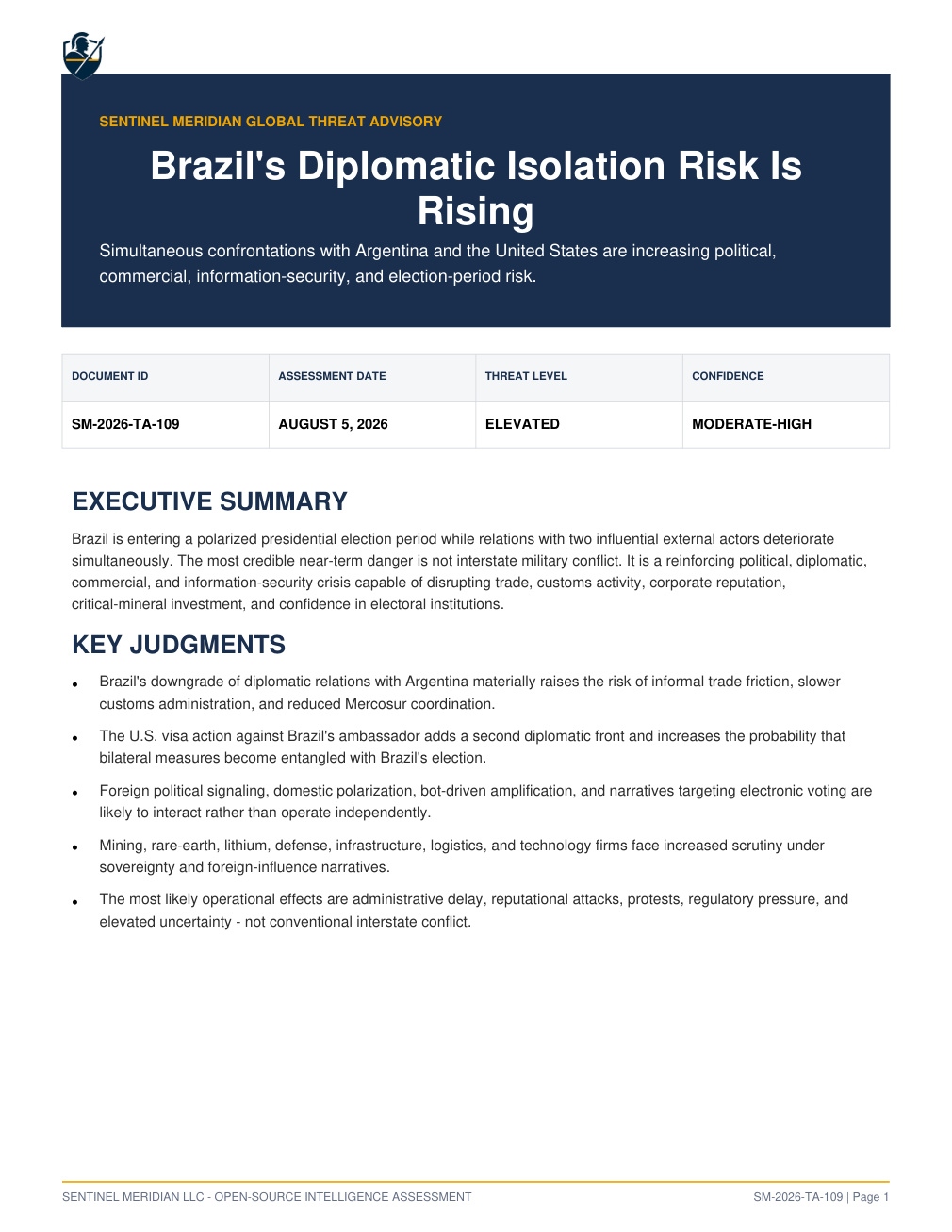
Simultaneous confrontations with Argentina and the United States are increasing political, commercial, information-security, and election-period risk.
Update — 28 September 2026
VERIFIED DEVELOPMENTS. Reuters reported on 22 September 2026 that President Lula warned against foreign interference and disinformation around Brazil's October election. The first round is scheduled for 4 October 2026, with a runoff, if required, on 25 October.
SENTINEL MERIDIAN ASSESSMENT. Public warnings about foreign interference during the campaign add a diplomatic dimension to this assessment's isolation-risk analysis. We assess with moderate confidence that disputes over interference claims could strain bilateral relationships during and after the campaign, independent of the result. This assessment does not predict or rank electoral outcomes.
Update — 7 October 2026
VERIFIED DEVELOPMENTS. Reuters reported on 4 October 2026 that Brazil's first-round presidential vote produced a runoff between Flávio Bolsonaro and Luiz Inácio Lula da Silva, with roughly 47% and 45% respectively as reported by Reuters. The runoff is scheduled for 25 October 2026.
ATTRIBUTED CLAIMS. Reuters reported on 5–6 October 2026 that Lula is considering Geraldo Alckmin as finance minister if re-elected; the proposal remains under discussion. Reuters reported on 7 October 2026 that Flávio Bolsonaro proposed a broad review of Lula-era tax reforms, including consumption-tax changes, a crude-oil export tax, and financial-transaction taxes. These are campaign positions, not enacted policy.
SENTINEL MERIDIAN ASSESSMENT. The risk picture shifts from pre-election to runoff and certification risk. We assess with moderate confidence that the period through 25 October and the subsequent certification window carries elevated exposure to disinformation, localised protest, and legal challenges, and that divergent fiscal, tax, and energy-export positions increase policy uncertainty for investors. Sentinel Meridian does not predict the winner and does not endorse or rank any candidate.
OPERATIONAL IMPLICATIONS. Prepare business-continuity plans for protest activity around the runoff and certification, monitor official electoral-authority communications to counter disinformation, and scenario-plan tax and energy-export policy under both stated platforms without assuming an outcome.
Key judgments
- Political Risk — assessed as a driving factor in this analytic line, tracked over the Through October 2026 forecast horizon.
- Foreign Influence — assessed as a driving factor in this analytic line, tracked over the Through October 2026 forecast horizon.
- Elections and Governance — assessed as a driving factor in this analytic line, tracked over the Through October 2026 forecast horizon.
- Supply Chains — assessed as a driving factor in this analytic line, tracked over the Through October 2026 forecast horizon.
- Mining and Critical Minerals — assessed as a driving factor in this analytic line, tracked over the Through October 2026 forecast horizon.
Sources and references
- Reuters, reporting on President Lula's warnings against foreign interference and disinformation, 22 September 2026.
- Reuters, reporting first-round presidential results and the 25 October runoff, 4 October 2026.
- Reuters, reporting that Lula is considering Geraldo Alckmin as finance minister if re-elected, 5–6 October 2026.
- Reuters, reporting Flávio Bolsonaro's proposed review of Lula-era tax reforms, 7 October 2026.
- Source-verification note (7 October 2026 update): the Reuters reporting descriptions and dates above were supplied for this update; original articles were not independently retrieved. Sentinel Meridian judgments are interpretation, not additional reported events.
The full assessment, including sourcing, analytic confidence statements, and indicators and warnings, is available in the downloadable PDF.
Download full PDF